

Industry News
Cement Raw Materials Grinding Mill Supplier for Portland Cement in India
2026-01-09 10:25:21
We are Liming Heavy Industry, a manufacturer of various types of industrial crushers, such as Raymond Mill, Trapezoidal Mill, Vertical Mill, Ultrafine Mill, Ball Mill, etc.
Our mills can process the following minerals:
limestone, quicklime, kaolin, talc, barite, bentonite, calcium carbonate, dolomite, coal, gypsum, clay, carbon black, slag, cement raw materials, cement clinker, etc.
If you need a mill to process stone or minerals into powder, please feel free to contact me (WhatsApp: +86 153 3380 7511). Thank you.

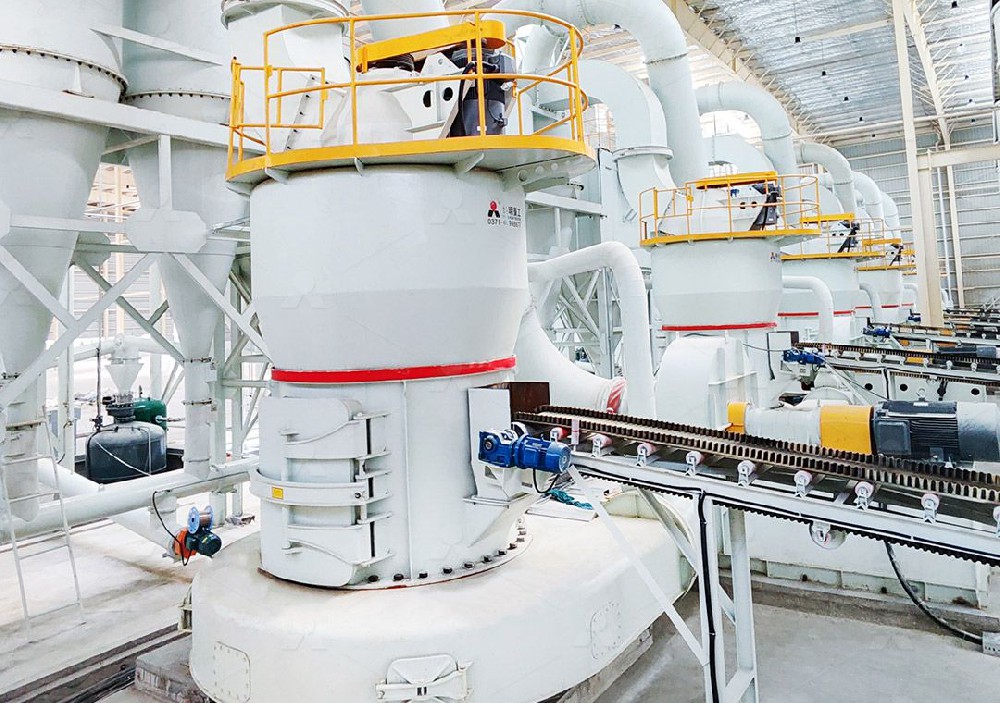
India currently stands as the second-largest cement producer in the world. With the government's aggressive push for infrastructure development—ranging from high-speed rail corridors to massive urban housing projects—the demand for high-quality Portland cement has never been higher. However, the heart of a cement plant's efficiency lies not just in the kiln, but in the raw material preparation stage. Achieving the perfect chemical homogeneity and fineness of raw meal is critical for the subsequent calcination process.
Liming Heavy Industry has emerged as a cornerstone supplier in the Indian market, providing sophisticated grinding technologies that address the specific challenges of Indian limestone and auxiliary materials. By integrating the reliability of Raymond Mills with the high-capacity efficiency of Vertical Roller Mills (VRM), Liming offers Indian manufacturers a localized solution for global-standard cement production.
The Science of Raw Meal Preparation
Before limestone, clay, and iron ore enter the kiln to become clinker, they must be ground into a fine powder known as "raw meal." The quality of this meal is often judged by its Lime Saturation Factor (LSF). In professional cement chemistry, the LSF formula is represented as follows:
LSF = [ CaO / (2.8SiO2 + 1.2Al2O3 + 0.65Fe2O3) ] × 100
To ensure this chemical balance reacts correctly during burning, the particles must be ground to a fineness where 85-90% pass through a 90 μm sieve. This is where the precision of Liming's grinding mills becomes the deciding factor in plant profitability.
Raymond Mills: The Evolution of Proven Technology
For decades, the Raymond Mill has been the workhorse of the Indian grinding industry. However, traditional designs often struggled with high energy consumption and frequent maintenance. Liming Heavy Industry has modernized this classic with the MTW European Type Trapezium Mill (an advanced Raymond Mill variant).
_1761355701097.jpg)
Key Advantages for Indian Operators:
Integral T-shape Grinding Path: This design increases the effective grinding area, ensuring that material stays in the pressure zone longer, resulting in a more uniform particle size distribution.
Internal Oil Lubrication: Unlike older models that required manual greasing every few hours, the MTW series uses an internal oil pump system, allowing for 24/7 continuous operation—a necessity for the Indian cement sector.
Reduced Energy Consumption: The specific power consumption (E = P / Q) is significantly lower than traditional pendulum mills, saving lakhs of rupees in monthly electricity bills.
For a small to medium-scale Portland cement plant focusing on "Specialty Cement" or "White Cement," the MTW series offers a footprint-to-output ratio that is hard to beat.
Vertical Roller Mills (LM Series): The Industrial Giant
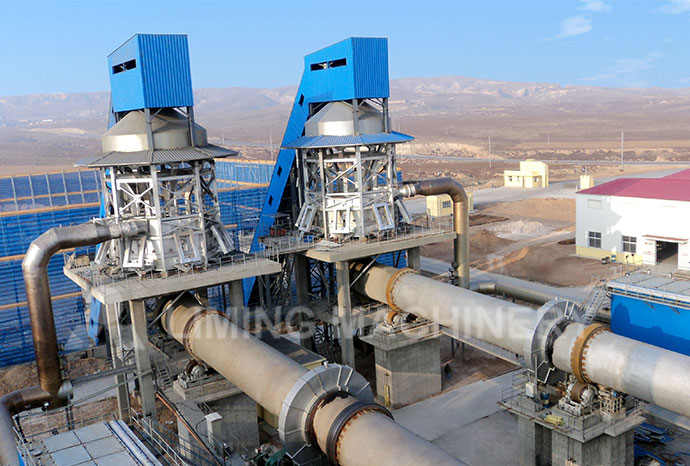
As Indian cement plants scale up to meet regional demands, the LM Vertical Roller Mill (VRM) has become the preferred choice for raw meal grinding. The VRM simplifies the production line by combining four processes into one unit: crushing, drying, grinding, and classifying.
Why VRM Wins in the Raw Meal Section:
Handling High Moisture: Indian limestone quarries often deal with varying moisture levels, especially during the monsoon season. The LM Vertical Mill uses hot air from the kiln preheater to dry materials with up to 15% moisture while grinding.
Operational Efficiency: The grinding rollers do not make direct contact with the table, which reduces wear and prevents "metal-on-metal" noise. The pressure is applied via a hydraulic system, allowing for real-time adjustments based on the hardness of the feed material.
Space Saving: Compared to a ball mill circuit, an LM Vertical Mill requires roughly 50% less floor space, which is critical given the rising land costs in industrial hubs like Gujarat, Rajasthan, and Andhra Pradesh.
View Technical Comparison: MTW vs. LM Series (Click to Expand)
| Feature | MTW Raymond Mill (European) | LM Vertical Roller Mill |
|---|---|---|
| Max Feed Size | < 50 mm | < 110 mm |
| Capacity | 3 - 50 TPH | 10 - 250 TPH |
| Final Fineness | 1.6 - 0.045 mm | 0.075 - 0.045 mm |
| Drying Capability | Limited | High (up to 15% moisture) |
| Application | Medium scale / Fine powder | Large scale / Raw meal / Slag |
Optimizing the Grinding Process for Indian Conditions
In India, power quality and ambient temperature can fluctuate significantly. Liming's mills are engineered with reinforced gearboxes and PLC-based control systems that stabilize the grinding pressure. When calculating the throughput of the mill (Q), we consider the bond work index of the limestone (Wi):
P = 10 × Wi × [ (1 / √P80) - (1 / √F80) ] × Q
By optimizing the P80 (product size) through Liming's high-efficiency cage-type classifier, operators can minimize "over-grinding." Over-grinding is a common waste of energy where particles are ground finer than necessary for the kiln reaction, leading to unnecessary power draw.
_1761355701094.jpg)
The Liming Advantage in the Indian Market
Success in the Indian cement industry isn't just about selling a machine; it's about the "Life Cycle Support." Liming Heavy Industry has established a robust service network across the subcontinent.
Localized Spare Parts: Strategic warehouses ensure that wear parts like rollers and segments are available to minimize downtime.
Customized Liners: Depending on the abrasiveness of the local Indian limestone (which can vary from the soft deposits of Tamil Nadu to the harder stones of Madhya Pradesh), Liming provides customized alloy compositions for grinding media.
Local Expertise: Our engineers assist in the commissioning and training of local staff, ensuring that the mill operates at its peak efficiency curve from day one.
Conclusion
Building a sustainable and profitable Portland cement plant in India requires a balance between capital expenditure (CAPEX) and operational expenditure (OPEX). Liming Heavy Industry's MTW Raymond Mills and LM Vertical Roller Mills provide the perfect technological bridge. Whether you are a boutique producer looking for high-fineness specialty products or a large-scale manufacturer aiming for 5000 TPD clinker production, Liming's grinding solutions offer the durability, energy efficiency, and technical precision required to lead in the Indian market.
FAQ: Cement Raw Material Grinding in India
1. Which mill is better for Indian limestone, the Raymond Mill or the Vertical Roller Mill?
It depends on your capacity. For outputs under 30-40 TPH, the MTW Raymond Mill is highly cost-effective and easy to maintain. For large-scale Portland cement plants (over 50 TPH), the LM Vertical Roller Mill is superior due to its integrated drying capability and lower specific power consumption.
2. Can Liming mills handle materials with high moisture?
Yes. The LM Vertical Roller Mill is specifically designed for this. It can utilize waste heat from the kiln to dry materials with a moisture content of up to 15% while grinding simultaneously.
3. What is the typical fineness achieved for Portland Cement raw meal?
Most Indian plants aim for a fineness where 88% of the material passes through a 90 μm (170 mesh) sieve. Both Liming MTW and LM mills can easily achieve and exceed this requirement with adjustable classifiers.
4. How does the power consumption of these mills compare to traditional ball mills?
The LM Vertical Roller Mill typically saves 30% to 50% in energy compared to a traditional ball mill system, as it avoids the massive weight of grinding balls and utilizes a more efficient crushing/shearing mechanism.
5. Does Liming provide on-site installation and after-sales service in India?
Yes, Liming has a dedicated service presence in India, providing installation guidance, operator training, and a supply of wear parts to ensure long-term operational stability.
_1761355927036.jpg)
6. Can these mills be used for grinding Coal or Petcoke for the kiln burner?
Absolutely. Liming provides "Explosion-Proof" versions of the LM Vertical Mill specifically designed for grinding coal and petcoke, equipped with CO sensors and pressure relief valves.
7. Is it difficult to replace the wear parts (rollers and tables)?
Liming's LM series features a "swing-out" device for the rollers. This allows the rollers to be moved outside the mill housing for easy maintenance or replacement of the roller sleeves, significantly reducing downtime.
8. What is the expected lifespan of the grinding rollers?
Depending on the abrasiveness of your limestone, the high-chromium alloy rollers can typically last between 8,000 to 12,000 hours before requiring resurfacing or replacement.
9. How do I determine the right size mill for my plant?
We recommend sharing your target TPH (tonnes per hour), the hardness of your limestone (Mohs scale), and the initial moisture content. Our engineers use these parameters to calculate the mill model that keeps your power-to-output ratio at its most efficient.
10. Do these mills comply with Indian environmental regulations?
Yes, both the MTW and LM series operate under negative pressure, which prevents dust spillover. When paired with Liming's high-efficiency pulse bag filters, dust emissions are well below the 30 mg/Nm³ standard often required by Indian pollution control boards.


